
Mitsubishi Electric Cooling & Heating systems operate on an entirely different engineering logic than traditional American central furnaces and split air conditioners. Built around variable-capacity inverter compressors, linear expansion valves (LEVs), and communicating indoor air handlers, these systems deliver pinpoint zone comfort—but require manufacturer-specific diagnostic tools and training when an inverter board faults, a flare connection leaks, or a blinking timer LED signals a lockout.

Best Heating Cooling & Air provides specialized Mitsubishi Electric HVAC repair, new ductless and ducted installation, and deep preventive maintenance in Denver, CO. Our NATE-certified technicians service M-Series, P-Series, and Hyper-Heating INVERTER® (H2i®) systems across residential homes and commercial properties, restoring factory performance and efficiency.
Anatomy of a Mitsubishi Electric System—and Where We Focus Service
Rather than relying on simple 24-volt on-off relays, a Mitsubishi Electric system functions as a continuous digital network. Direct current (DC) signals travel constantly between the outdoor inverter and indoor heads to adjust capacity on the fly. To keep this complex network running smoothly, we service every part of the system:
- Communicating Indoor Heads (M-Series): Servicing wall-mounted units (MSZ/MFZ), floor-mounted consoles, ceiling cassettes (MLZ/SLZ), and horizontal-ducted air handlers (PEAD/SEZ) paired with MXZ multi-zone condensers.
- Hyper-Heating INVERTER® (H2i®) Heat Pumps: Maintaining and diagnosing high-output heat pump systems engineered to deliver reliable, efficient heating in sub-zero Colorado winter temperatures without relying on backup heat.
- P-Series & Commercial Systems: Servicing high-capacity ducted air handlers, ceiling-suspended units (PCA), and side-discharge condensers (PUZ) used in server rooms, offices, and retail spaces.
- Smart Control Systems: Configuring and troubleshooting Kumo Cloud® Wi-Fi adapters, MHK2 wireless wall thermostats, PAR wired controllers, and third-party thermostat interface modules.
Precision Mitsubishi Electric Mini-Split and Heat Pump Repair
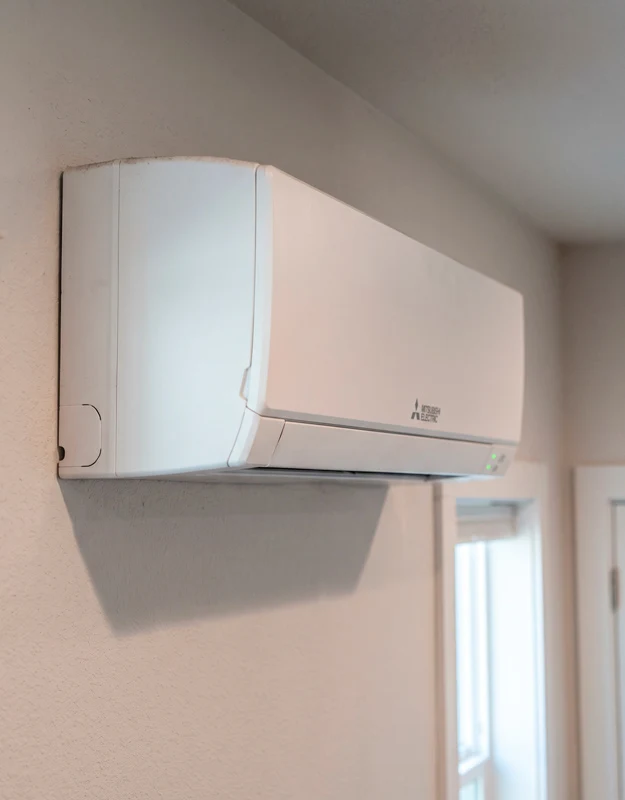
Because Mitsubishi Electric equipment relies on continuous communication between its indoor and outdoor boards, guessing at parts can leave underlying faults unresolved. Our diagnostic process isolates the exact electrical, refrigerant, or drainage failure:
- Diagnostic Blink Codes & Serial Error Codes: Reading indoor operation/timer LED flash patterns and controller codes (like U, P, or E series faults) to trace S1-S2-S3 communication drops, outdoor PCB faults, or inverter IPM module failures.
- Flare Connection & Refrigerant Leak Repairs: Inspecting flared copper joints, branch boxes, and evaporator U-bends for R-410A leaks. We re-flare with torque-calibrated tools, pressure test with dry nitrogen, and weigh in exact factory refrigerant charges.
- Thermistor & Linear Expansion Valve (LEV) Testing: Measuring resistance drift across pipe, ambient, and defrost thermistors, and verifying LEV modulation when a zone blows warm air or freezes over.
- Condensate Drain & Lift Pump Failures: Clearing algae-blocked gravity drain lines and servicing internal or external condensate lift pumps that trigger float-switch shutdowns and water leaks.
The Denver Winter Defrost Challenge for Heat Pumps
Operating a heat pump at Mile High elevation means dealing with heavy snow, ice, and sub-freezing temperatures. In winter, moisture naturally freezes on the outdoor condenser’s tightly spaced coil. Mitsubishi’s demand defrost boards monitor this ice buildup to periodically reverse the system, sending heat outdoors to melt it away.
If the outdoor unit isn’t mounted at least 12 inches above the ground on snow risers, or if the base pan heater fails, melting ice can re-freeze at the base, damage the coil, or trigger a lockout. During every service visit, we check defrost cycle operation, verify that the base pan heater is clear of debris, and ensure the unit sits high enough to handle Denver’s snowpack.
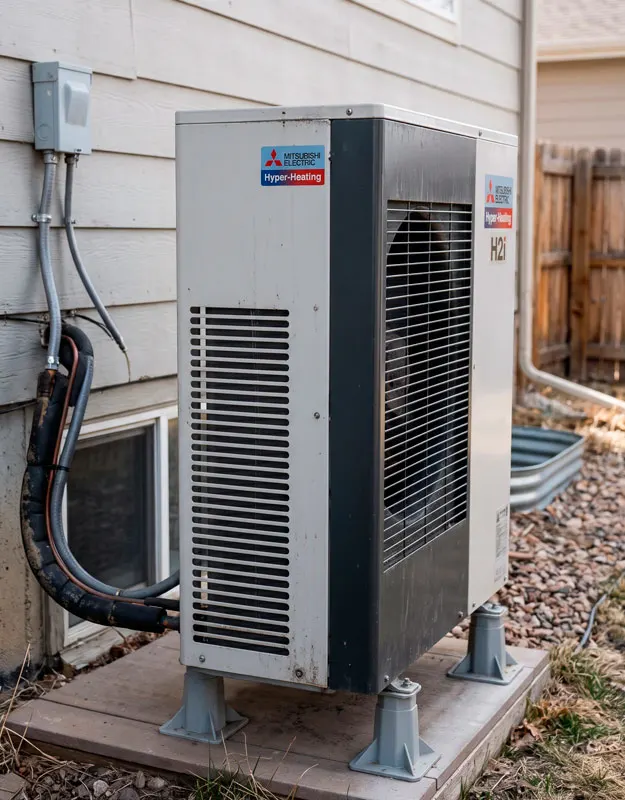
Installing Cold-Climate Hyper-Heating (H2i®) Systems Properly
A Mitsubishi Electric ductless or ducted heat pump only achieves its rated efficiency and winter output when installed to exact factory tolerances. Every installation begins with a room-by-room Manual J load calculation so individual indoor heads are neither oversized (causing short cycling and humidity swings) nor undersized for Denver’s coldest nights.
To prevent electrical noise from disrupting S1-S2-S3 digital communication, our technicians run continuous 14 AWG 4-conductor stranded wire directly between the indoor and outdoor units with zero splices. We use digital flare wrenches to torque every refrigerant joint, purge the lines with dry nitrogen, and pull a deep vacuum below 300 microns to keep moisture out of the system.
Deep Cleaning and Preventative Maintenance for Mini-Splits
Unlike standard central air conditioners with thick pleated media filters, ductless indoor heads pull room air across fine mesh screens directly onto a compact cylindrical blower wheel and tightly spaced evaporator fins. Over time, household dust, pet dander, and Denver’s dry airborne grit coat the blower wheel, cutting airflow, causing musty odors, and forcing the inverter compressor to work harder.
Our seasonal Mitsubishi Electric maintenance includes washing reusable mesh and anti-allergen filters, performing a bib-contained coil and blower wheel flush, clearing condensate pans and drain lines, cleaning outdoor condenser coils, and verifying inverter amperage and defrost cycle operation.
When to Repair vs. Replace an Aging Mitsubishi Unit
If your Mitsubishi mini-split or multi-zone heat pump is under 10–12 years old, repairing the system is usually the wisest path. Replacing failing wear parts—such as a sensor, a thermistor, a fan motor, a flare fitting, or even an indoor control board—typically restores the system to full operation for a fraction of the cost of a new system.
However, if your equipment has more than 15 years of service and faces a failed outdoor inverter board, a burned-out compressor, or multiple leaks in an obsolete R-22 system, investing in a major repair may not be economical. Modern Mitsubishi Electric systems offer significantly higher efficiency (SEER2/HSPF2) and better cold-climate performance, and they come with a new 10-to-12-year parts warranty to provide long-term peace of mind.
What Determines Mitsubishi Electric Service and Installation Estimates?
Every appointment starts with thorough hands-on testing so your written quote reflects verified site conditions:
- Whether a repair involves sensor/thermistor replacement, flare re-machining and refrigerant recharge, condensate pump service, or outdoor inverter board replacement.
- The number of indoor zones, BTU capacity, and standard vs. Hyper-Heating (H2i®) outdoor condenser selected for new installations.
- Line-set routing length, exterior line-hide concealing, branch box placement, and dedicated electrical disconnect requirements under Denver codes.
- Applicable manufacturer parts warranty coverage, especially if the system was installed by a certified Diamond Contractor.
Your technician reviews a transparent, flat-rate written quote before any work begins, backed by our parts and workmanship warranty.
Book Mitsubishi Electric HVAC Service in Denver, CO
Whether your mini-split is blinking an error code, leaking water, or ready for a cold-climate Hyper-Heating upgrade, call Best Heating Cooling & Air at (720) 201-3894 or request service online in Denver, CO.
Mitsubishi Electric HVAC FAQs
Why is the operation or timer light blinking on my Mitsubishi mini-split?
A blinking LED pattern on a Mitsubishi indoor unit indicates a system fault code—commonly tied to a communication error between indoor and outdoor boards, a tripped condensate float switch, a thermistor fault, or an outdoor inverter protection lockout. Counting the exact flash sequence helps our technicians pinpoint the subsystem quickly.
Can Mitsubishi Electric Hyper-Heating heat pumps warm a home in Denver below freezing?
Yes. Mitsubishi Electric Hyper-Heating INVERTER® (H2i®) systems are specifically engineered for cold climates, delivering up to 100% of rated heating capacity down to 5°F and continuing to operate efficiently at outdoor temperatures as low as -13°F.
Why does my Mitsubishi wall unit smell musty or blow weak air?
Dust and moisture naturally build up on the internal cylindrical blower wheel and tightly spaced evaporator fins. Standard vacuuming of the front mesh screen will not reach the blower wheel—a professional bib-wash deep cleaning restores full airflow, eliminates musty odors, and prevents the unit from overworking.
Can I connect a standard smart thermostat to a Mitsubishi Electric system?
Because Mitsubishi Electric systems use proprietary communicating controls rather than standard 24-volt thermostat wiring, connecting a standard smart thermostat requires installing a dedicated Thermostat Interface adapter. Alternatively, using Mitsubishi’s native MHK2 wireless controller or Kumo Cloud® app preserves the system’s full variable-speed inverter modulation for maximum efficiency.
Brands We Service




Where We Service Mitsubishi Electric Systems
Testimonials
Reviews About us on Google My Business

Best HVAC Company in Colorado

Professional Workers

License & Insured
List of service offered by Best Heating Cooling & Air
Best Heating Cooling & Air licensed, insured, NATE certified. As a Trade Partner we are able to provide for our customers rebate program for new installations.