At breakfast, the kitchen tap delivers hot water normally. By evening, the shower loses warmth halfway through, and you wonder whether the heater is failing or the household simply used more water. The distinction matters: the same experience can arise from demand, plumbing, controls, or a damaged component. Identifying a Rheem water heater problem starts with describing what changed rather than selecting a replacement part.
First establish which appliance supplies the water. A conventional electric tank, a gas storage heater, a hybrid heat-pump unit, and a tankless model do not share every failure mechanism. Record the model, operating mode where applicable, and any alert shown on the display. Even within one product family, a troubleshooting instruction may apply only to a particular configuration.
1. Tank Leaks and Corrosion
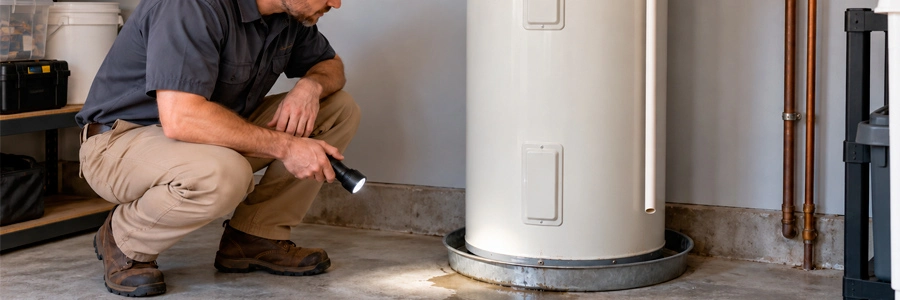
The lowest wet point is often where water finishes its journey, not where the leak begins. A droplet escaping near the upper fittings can follow the outer casing before reaching the floor. Water from another pipe can also collect around the heater and make the appliance look responsible.
With a Rheem water heater leaking from the top, the inspection usually begins around the visible connections and other potential entry points. An inlet, outlet, or anode connection may be involved. The important finding is whether water escapes from a serviceable fitting or from damage to the storage vessel.
A Rheem water heater leaking from the bottom calls for the same source-first approach. The drain assembly, a leak tracking down from above, condensation, and a deteriorated tank are different possibilities. A wet base alone cannot distinguish them, and replacing a valve will not repair a corroded vessel.
Another clue is whether water comes from the relief discharge. The temperature-and-pressure relief valve protects the appliance; closing off its discharge is never an acceptable way to stop a drip. A professional must evaluate the pressure or temperature condition, the valve, and the installation before deciding what needs correction.
For active leakage, prioritize safe access and prompt service. Stay away from electrical equipment affected by water, and follow the model’s shutdown guidance only if the controls can be reached safely. Where useful, document the wet area before it dries, but do not continue normal operation merely because the spill fits inside a pan.
Sacrificial Anode Rod Depletion
A storage heater can deliver a perfectly satisfactory shower while its corrosion protection is reaching the end of its useful life. In designs using a sacrificial anode, the rod’s protective material is consumed as part of its function. Its condition therefore belongs in maintenance planning rather than being assessed solely when hot-water delivery changes.
Rheem water heater anode problems require consideration of the unit, the water, and the vessel’s condition. Rust-colored hot water is a reason to investigate, not confirmation that a new rod will resolve everything. Supply water and connected piping can contribute to discoloration too.
Replacing a depleted anode can protect a tank that remains serviceable. It cannot reverse existing perforation or rebuild corroded steel. Removing the rod permanently to address a smell sacrifices protection, so any alternative anode or treatment should be selected for compatibility with the heater and the water conditions.
2. Sediment and Scale Buildup
Some changes develop over many months instead of appearing as a sudden failure. The heater becomes louder, recovery seems slower, or the household notices less usable hot water without changing the thermostat. Among common problems with Rheem water heaters, deposits deserve consideration because heated surfaces and water passages can accumulate material that is not visible from outside.
A storage tank and a tankless heat exchanger collect deposits in different places. Material near the bottom of a tank can affect the heating environment, while scale in a narrow heat-exchanger passage can influence flow and heat transfer. The appropriate service method follows the design and the findings.
Still, deposits should not become the default explanation for every performance complaint. An additional person using hot water, a failed heating stage, or a mixing problem may create similar symptoms. Compare the current routine with the conditions under which the heater previously performed well.
Water quality and use help determine the maintenance plan. Tank flushing and tankless descaling are separate operations, not interchangeable names for one treatment. Before work begins, ask what evidence supports the recommendation and which procedure the manufacturer permits for that model.
Why Is My Water Heater Making Noise?
The description “noisy” leaves several useful details unanswered. Does the sound occur only while water heats, when a tap shuts, or whenever a fan runs? A Rheem water heater making noise can be reporting an appliance condition, normal mechanical operation, or a disturbance in the connected plumbing.
Rumbling and popping during a tank’s heating cycle can accompany deposits around heated surfaces. A knock synchronized with a closing faucet may lead the investigation toward plumbing behavior instead. On hybrid and power-vent equipment, fans and blowers add sounds that a simple electric storage tank would not make.
Rusty Water and Rotten Egg Smell
Begin with the distribution of the complaint. If only one fixture produces discolored water, that differs from several fixtures showing the same change. If the cold supply has the same odor or color as the hot supply, the investigation needs to extend beyond the heater.
A Rheem water heater’s rotten egg smell may involve sulfur compounds, microbial activity, water chemistry, and anode interaction. The right response depends on how those factors apply at the property. A product added without diagnosis may leave the source unchanged or be unsuitable for the equipment.
Persistent rusty water also deserves a source check. Corrosion in the vessel is one possibility, but a hot-water complaint is not enough to exclude piping or supply conditions. Inspection can establish whether maintenance, a compatible anode option, other treatment, or replacement needs consideration.
Keep water odor separate from a possible fuel-gas leak. If you suspect escaping gas near a gas-fired heater, leave the building without trying to light the appliance or operating electrical switches. Call the gas supplier or emergency services from outside; this is not a situation for testing whether a different water-heater setting changes the smell.
3. Electrical and Thermostat Issues
An electric heater’s temperature setting expresses the desired result, not proof that every heating component can deliver it. One household may lose all hot water, while another still gets a warm shower that ends unusually quickly. The circuit and heating sequence determine how a fault presents itself.
Service may need to distinguish an interrupted supply from damaged wiring, a failed element, a control problem, or a protective shutdown. A display that remains on does not establish that power reaches every component correctly. Appropriate testing is required before selecting parts.
Hybrid and electronically controlled products can report additional sensor or operating-mode information. Save the full message, including letters or numbers, instead of paraphrasing it as a thermostat error. A displayed warning can identify a detected condition without identifying the component that caused it.
Burnt Heating Elements and Tripped Limits
In a two-element storage design, one component’s failure can affect the amount of hot water available without making the tank completely cold. The precise pattern depends on the model and its sequence. Measuring the elements and controls gives a firmer basis for repair than judging them by the temperature at a single faucet.
Rheem water heater thermostat problems can include failure to regulate heating as intended, but an element or connection fault can produce overlapping symptoms. The technician needs to establish both the failed function and the condition of the associated circuit. Replacing a thermostat simply because the water is lukewarm may miss the actual fault.
A tripped high-temperature limit or circuit breaker should also be treated as information. Repeated resetting restores neither confidence in the circuit nor an explanation for the interruption. A protective device must not be bypassed to keep heating available while the underlying problem remains unknown.
Repairs that drain the tank require correct return-to-service procedures afterward. An electric element can be damaged if energized without the necessary water coverage. Restoring operation therefore includes checking the installation and following the manufacturer’s sequence, not merely reconnecting a new component.
Broken or Deteriorated Dip Tube
The dip tube belongs to the water path, even though its symptoms can resemble an electrical heating failure. In many storage tanks, it carries incoming cold water downward, away from the hot outlet. Damage can allow incoming water to mix higher in the tank and reduce the usable hot-water draw.
Rheem water heater dip tube problems are worth considering when temperature falls rapidly despite apparently functioning heating equipment. They remain one possibility among several, including demand and mixing faults. Confirm the condition before assuming that a new tube, a larger heater, or a higher setting will solve the complaint.
4. Gas Water Heater Ignition Errors
Describe the stopping point before describing the suspected part. A standing pilot that goes out, an electronic ignition attempt that never produces flame, and a burner that lights briefly then stops are not the same sequence. Rheem gas hot water heater problems need to be assessed against the installed ignition design.
The fault may concern fuel delivery, ignition, flame verification, combustion conditions, or a control correctly preventing operation. Any status light or code must be interpreted using the relevant manual. A chart for a different gas control may turn the same-looking indication into a misleading diagnosis.
Leave pressure adjustments, internal connections, and safety-circuit testing to qualified service personnel. Repeated lighting attempts or resets do not establish that continued use is safe. When the permitted checks in the owner’s instructions do not resolve the issue, professional assessment should address why the normal sequence failed.
Gas Valve Failures and Lockouts
The absence of burner flame does not prove a Rheem water heater gas valve problem. A functioning valve can remain closed because another required condition has not been satisfied. Fuel supply, control inputs, and protective devices need to be evaluated before the valve is condemned.
A useful diagnosis explains what prevented operation and how that finding was confirmed. If a replacement valve is necessary, it must suit the appliance and fuel, with the required installation and commissioning checks included. Physical resemblance between two controls does not establish interchangeability.
Venting and Draft Issues (Power Vent)
A power-vent heater relies on a blower and an approved exhaust arrangement to remove combustion products. Rheem power vent gas water heater problems can arise when that arrangement cannot establish the required operating conditions. The heater may then withhold ignition or interrupt the sequence.
The investigation can involve the blower, vent piping, terminal, air supply, controls, and the model’s protective devices. A visible obstruction, damaged connection, or component fault calls for different corrective work. Hearing the blower spin is not a measurement of satisfactory vent performance.
Venting must remain connected and safety devices functional throughout operation. Do not improvise an exhaust route or defeat a switch to get hot water temporarily. If a carbon-monoxide alarm sounds, leave the building and contact emergency services rather than remaining inside to diagnose the appliance.
5. Heat Pump Problems
A hybrid heater can have more than one way to warm the stored water. That makes some failures less obvious: backup elements may still deliver hot water while the heat-pump section reports a fault. Rheem heat pump water heater problems should therefore be assessed through operating mode and alerts as well as water temperature.
Slow recovery is not automatically compressor failure. High simultaneous demand, the selected mode, surroundings outside the model’s specified conditions, or an airflow restriction may influence performance. Compare what changed before choosing a repair path.
- Identify the active mode and whether the complaint began after a setting change or a different household usage pattern.
- Follow the manual for accessible filter care and keep the specified air openings and equipment clearances available.
- Distinguish condensate-drainage concerns from water escaping from the tank or plumbing connections.
- Record complete alerts and persistent changes in sound or recovery for a model-specific service assessment.
Changes around the appliance can matter as much as changes inside it. Building a cupboard around a previously open installation, or obstructing its air route with storage, can alter the conditions it depends on. The space or ducting arrangement must remain consistent with the selected model’s requirements.
6. Common Tankless Water Heater Problems
A tankless unit has no stored reserve to mask changes in demand or incoming water conditions. Its output depends on the equipment’s capacity and the task at that moment. Rheem tankless water heater problems can therefore involve the appliance itself, restricted water movement, or expectations that exceed what the installation can provide.
Start by separating gas from electric equipment. Gas models have combustion and venting considerations that do not apply to electric models; electric units have their own supply and heating requirements. Even when both show an alert, their code lists and diagnostic procedures are not interchangeable.
Notice whether one outlet or the entire house is affected. A troublesome shower can involve its mixing arrangement or local flow, while a broader complaint may call for checks at the heater and supply. Record when the temperature changes and which other hot-water outlets were running.
Scale, restricted passages, inadequate activation flow, and component faults are additional possibilities. Certain gas models distinguish ignition failure, loss of flame, and air-related conditions through separate codes. The correct manual is essential because a number copied from another product’s chart may mean something different.
Where descaling is indicated, the method and interval should follow the manufacturer and the water conditions. It does not substitute for correcting an electrical failure, a venting defect, or a damaged component. Ask how the proposed work relates to the observed fault and how normal delivery will be verified afterward.
Conclusion
Sorting problems with Rheem water heaters becomes easier when the initial notes are specific. Identify the appliance, preserve the exact alert, describe the location of any water, and record whether the complaint follows heating or water use. Those observations give a professional something concrete to investigate.
The final decision may involve maintenance, a component repair, installation corrections, or replacement of deteriorated equipment. Base that decision on confirmed condition and a defined scope rather than a familiar symptom alone. Contact Best Heating Cooling & Air to discuss the service request and arrange the next step for an assessment.