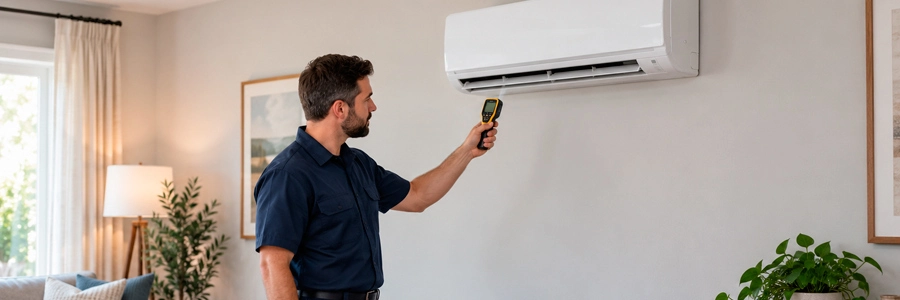
The indoor fan is moving, the remote shows a cooling symbol, and the room still feels warmer than it should. On another day, the same equipment may pause before starting and then operate normally. Understanding Daikin air conditioning problems means distinguishing an expected operating sequence from a fault, a setting, or a condition outside the appliance.
Start with the exact installation. A wall-mounted mini-split, a multi-zone arrangement, and a ducted central system do not use identical controls or troubleshooting procedures. Keep the indoor and outdoor model details available, along with the controller identification and any message displayed when the complaint occurs.
1. Power and Communication Problems
A command has to travel from the control to the equipment before heating or cooling can begin. If nothing happens, the interruption may concern the command, the available power, communication between components, or a protective delay. The first useful distinction is whether the system has no visible response or responds without starting the expected operation.
Air Conditioner Won’t Turn On
If your Daikin AC is not turning on, check the selected mode, setpoint, timer, and controller display before assuming equipment failure. A scheduled start or a temperature setting that does not call for cooling can make an available system appear unresponsive. Weak remote batteries can create a similar impression.
A short pause after stopping or changing modes can also be intentional. Some Daikin manuals describe a restart-protection delay of approximately three minutes, although timing and behavior vary by product. Repeatedly pressing ON during that period does not help establish whether the equipment is faulty.
Check whether there has been a wider power interruption and whether an accessible, identified breaker appears tripped. Do not open electrical compartments or keep resetting a breaker that trips again. No lights, a recurring trip, or a persistent fault indication calls for assessment of the applicable supply and controls.
System Won’t Shut Off
When a Daikin air conditioner won’t turn off, identify which component continues operating. An outdoor fan running briefly after a stop command is different from continued cooling, while certain products may have a drying or protective function. The owner’s manual explains which post-operation behavior is expected.
Also distinguish long operation from refusal to stop. An inverter system can spend extended periods at reduced output while maintaining temperature. That alone does not indicate a stuck control. Continued operation despite a valid stop command, or operation well outside the selected settings, needs a different investigation.
Review timers and supported app schedules that could restart the equipment. If the control does not reliably stop the system, arrange service rather than treating repeated power interruptions as the normal way to operate it. Unusual heat, smoke, or a burning smell requires stopping use and prompt professional attention.
Remote Control Not Responding
If your Daikin AC remote control is not working, separate the remote’s display problem from the indoor unit’s response. A blank or fading display suggests checking the specified batteries and their orientation. A clear display with no equipment response raises questions about signal delivery, settings, or the receiving unit.
For an infrared remote, use the normal operating range and an unobstructed path to the receiver. Some environments can interfere with reception, and direct sunlight at the receiving area can matter. A wired controller or app uses a different communication path, so these infrared checks do not apply universally.
Use the remote supplied or approved for the equipment. A replacement that resembles the original may not support its full functions or communication requirements. Avoid undocumented button combinations; a setting change can complicate the complaint instead of resolving it.
2. Performance & Airflow Issues
Comfort depends on more than whether the appliance is switched on. Air must reach the occupied space, the equipment must operate in the required mode, and its available output must be appropriate to the conditions. A problem affecting one bedroom deserves different initial questions from a house that has lost cooling everywhere.
Not Cooling or Heating Properly
If a Daikin AC is not cooling, verify that the control requests cooling rather than fan-only operation or another mode. Then consider the fan setting, accessible filter condition, and anything blocking the indoor inlet or outlet. Follow the owner’s instructions for user-serviceable filters; internal cleaning is a separate task.
Air distribution matters even when the equipment produces conditioned air. A single wall unit may struggle to serve rooms behind closed doors, and furniture can obstruct its discharge. In ducted systems, a room-specific issue may concern a branch or return-air route rather than the outdoor unit.
For heat-pump operation, warm airflow may not begin immediately. Defrost and warm-up sequences can interrupt or delay indoor heat without indicating failure. The duration and accompanying behavior need to be checked against the model, particularly before applying a reset intended for cooling complaints.
Persistent poor performance requires operating measurements and inspection. A technician may need to assess airflow, controls, equipment capacity, electrical operation, and the refrigerant circuit. Simply choosing a more extreme setpoint does not correct a fault or increase the unit’s available capacity.
Refrigerant Leaks and Low Freon Levels
A Daikin AC refrigerant leak is one possible reason for declining performance, but warm supply air is not proof. Coil contamination, restricted airflow, and component faults can create overlapping symptoms. Even visible ice needs diagnosis rather than an automatic assumption about refrigerant quantity.
“Freon” is often used casually for refrigerant, but it does not identify the substance specified for every Daikin system. The equipment label and service documentation determine the refrigerant and procedure. Different types must not be treated as interchangeable.
Refrigerant circulates in a closed system; ordinary seasonal use should not require routine replenishment. If the charge is low, the cause needs investigation. A repair plan may involve locating and correcting a leak, verifying the repair, and restoring the specified charge using the manufacturer’s method.
Leave circuit access, pressure testing, recovery, and charging to qualified personnel. Do not add a retail refrigerant product or assume an odor identifies the refrigerant. Report changes in performance, visible ice, or other observations and let appropriate testing establish the condition.
3. Water Leaks and Drainage Faults
Cooling removes moisture from indoor air, so condensate is part of normal operation. It becomes a fault when the collection or discharge arrangement cannot carry it to the intended destination. A Daikin air conditioner leaking water needs a source check rather than an assumption that the entire appliance has failed.
Outdoor water and indoor leakage are not equivalent. Some heat-pump operation can produce water or steam outdoors during defrost, while cold outdoor piping can collect condensation. Water running onto an interior wall or through a ceiling requires a different response.
Consider whether the complaint follows a long cooling period, appears only in certain weather, or began after installation or maintenance. Those details can help distinguish drainage, insulation, operating-condition, and coil-related concerns. They do not replace inspection of the actual route.
Water Leaking from the Indoor Unit
A Daikin split system leaking water inside may have a restricted or incorrectly arranged drain, a pump fault where one is fitted, or another condition affecting condensate collection. Water can also appear when ice melts or when surfaces develop condensation outside the intended collection area.
Stop using a unit that is wetting the building or nearby electrical items, and arrange service. Protect surrounding belongings only where safe access is possible. Do not remove electrical covers or dismantle the indoor assembly to follow the water path.
The corrective work should include identifying the source and checking discharge afterward. Drying the visible cabinet or emptying a container below it does not establish that the drain now functions. If leakage followed recent work, explain the timing when requesting a return assessment.
4. Sensory Issues: Noises and Odors
A sound or smell becomes more useful diagnostically when connected to a particular event. Does it appear at startup, after a stop command, during defrost, or only at high fan speed? Recording that relationship is more informative than describing every unfamiliar sound as a compressor problem.
Distinguish a brief, familiar operating noise from a new persistent change. Likewise, an odor that appears at one fan speed or in one room may involve different conditions from a burning smell accompanied by electrical trouble. The response should match the observation.
Rattling, Buzzing, or Grinding Sounds
Some refrigerant-flow, valve, and material-expansion sounds are expected on particular models. A rattle can instead involve a loose component or surrounding object, while scraping or grinding may need inspection of moving parts. The name of the sound alone cannot locate the fault.
Note whether it comes from the indoor unit, outdoor unit, piping route, or nearby structure. A short recording from a safe position can preserve an intermittent complaint. Do not touch a fan, remove guards, or reach inside the equipment while trying to reproduce it.
Arrange prompt assessment for a new strong vibration, persistent grinding, or noise associated with loss of performance. Continued operation is not a useful test when mechanical damage is suspected. A technician should establish whether the source is the appliance, its mounting, or another part of the installation.
Musty Smells and Mold Buildup
A persistent Daikin air conditioner smell can originate from retained room odors, contaminated internal surfaces, or moisture-related conditions. The equipment circulates air from the space, so a smell at the outlet does not by itself prove that mold is growing inside.
Inspection should consider filters, accessible coil and blower surfaces, drainage, and relevant room sources. If cleaning is needed, the method must suit the equipment and protect its materials and electronics. Fragrance or an unsuitable household spray may mask the complaint without addressing it.
A burning smell is a separate warning condition. Stop operation, isolate power only if safe to do so, and seek professional assistance. Do not run the system again simply to determine whether the odor disappears.
Understanding Daikin Error Codes
Daikin air conditioner fault codes identify conditions recognized by a particular control system. They are starting points for diagnosis, not instructions to replace a part with a matching name. The same complaint can involve a sensor, its wiring, the condition being measured, or another connected component.
Obtain the code using the procedure for the installed controller. Some remotes can retrieve diagnostic information, while other products use a wired display, equipment indicator, or supported app. A generic sequence found for a different remote may change settings without retrieving the relevant fault.
- Record the full code exactly, including any letters, numbers, and additional displayed information.
- Identify the indoor unit, outdoor unit, and controller so the code can be checked against the applicable documentation.
- Note whether the alert affects one zone or multiple connected units and which mode was active.
- Explain whether the indication followed a power interruption, maintenance visit, or another observable change.
Preserve that information before any permitted restart. If the message returns, repeated clearing does not improve the diagnosis or repair a persistent condition. Request service with the recorded details rather than working through unrelated online code lists.
Quick Fix: How to Reset Your Daikin AC
Before searching for how to reset a Daikin air conditioner, decide what you expect the action to accomplish. Restarting normal operation, reinitializing a handheld remote, clearing a maintenance reminder, and interrupting equipment power are different actions. None should be assumed to repair a damaged component.
Record any fault indication first and read the relevant owner’s instructions. If there is indoor leakage, a burning smell, damaged wiring, a recurring breaker trip, or another condition calling for service, do not attempt repeated restarts. Have the condition assessed.
Soft Reset via Remote Control
For a basic operating restart, use the normal stop command, confirm the intended settings, and follow the manual’s instructions before requesting operation again. Allow the equipment’s protective delay to complete. Rapidly repeating ON and OFF commands can make normal waiting periods look like a new fault.
Do not assume a Daikin AC remote reset button exists or performs the same task on every controller. A recessed button may initialize the remote rather than reset the outdoor equipment, and a filter-reset command may only acknowledge maintenance. Identify the controller and the documented function before pressing an unfamiliar control.
If the remote has a fading or erratic display, replace its specified batteries as directed and restore any settings required by the manual. This can address a remote power issue, but it does not clear a fault inside the refrigeration or electrical system. If the equipment still does not respond, report that distinction.
Hard Power Reset at the Circuit Breaker
A Daikin hard reset is commonly used to describe a power interruption, although this is not necessarily a factory reset. Only attempt a power-cycle procedure when the model’s instructions recommend it for the observed condition, the dedicated breaker is correctly identified, and the panel is dry and safely accessible.
- Save the displayed fault information and stop normal operation using the controller where possible.
- Follow the manufacturer’s procedure for interrupting and restoring the identified equipment supply, including any specified waiting period.
- After power returns, allow initialization and restart-protection delays to finish before judging the response.
- Observe whether normal operation resumes or the original indication returns, and provide that result when arranging service.
There is no single off-time that can be assigned to every Daikin installation. Do not remove a panel cover, handle internal wiring, or use repeated breaker operation to keep a faulty system running. A breaker that trips again requires professional investigation rather than another reset attempt.
Conclusion
The clearest descriptions of Daikin air conditioner problems identify what happens, when it happens, and which parts of the installation are involved. Check routine settings and permitted filter care, preserve displayed information, and distinguish expected delays from persistent failure.
When the complaint involves ongoing leakage, abnormal noise, recurring alerts, or inadequate performance after basic checks, arrange professional assessment. Best Heating Cooling & Air can discuss your Denver-area service request and the information needed for the appointment. The aim is to correct the cause and verify operation, rather than repeatedly hide the symptom with a restart.