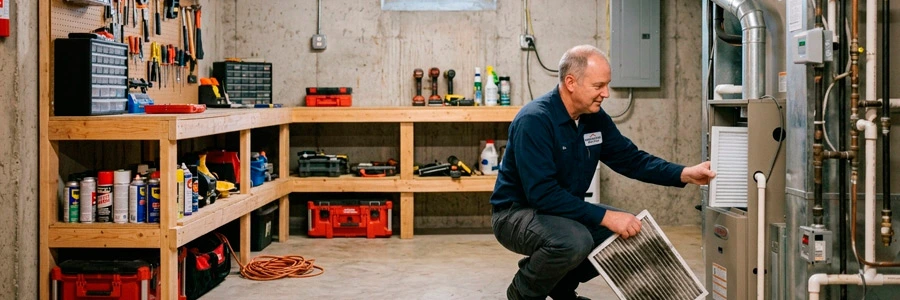
Every time your blower motor kicks on, your HVAC system pulls hundreds of cubic feet of air through a single barrier: the return air filter. In Colorado’s climate—where dry air, pine pollen, fine dust off the Front Range, and seasonal wildfire smoke collide—filter selection dictates far more than air cleanliness. It directly governs blower motor lifespan, coil heat transfer efficiency, and your monthly energy bills.
Homeowners often buy the densest filter on the shelf, assuming maximum filtration is automatically better. In field practice, dropping an overly restrictive filter into a standard residential furnace can starve the heat exchanger, spike static pressure, and push your system into limit-switch shutdowns. Here is a technical, field-tested breakdown of MERV 8, MERV 11, and MERV 13 filters so you can balance indoor air quality with equipment reliability.
The Physics Behind MERV: Balancing Filtration and Static Pressure
MERV (Minimum Efficiency Reporting Value) ranges from 1 to 16 for standard residential and light commercial equipment. The rating measures the percentage of airborne particles a filter catches across specific micron brackets (0.3 to 10 microns). However, catching smaller particles requires denser weaves of synthetic or fiberglass media.
In fluid dynamics, denser media introduces higher resistance to airflow, measured by HVAC techs as external static pressure (ESP) in inches water column (in. w.c.):
- Airflow Reduction: If a residential duct system is engineered for a total external static pressure of 0.50 in. w.c., an overly dense 1-inch filter taking up 0.30 in. w.c. leaves almost no pressure budget for supply runs, evaporator coils, or registers.
- Blower Motor Strain: Standard permanent split capacitor (PSC) motors slow down under high static pressure, delivering fewer CFM (cubic feet per minute) and overheating. Electronically commutated motors (ECM) will ramp up RPM to maintain airflow, consuming significantly more wattage and wearing out their control modules prematurely.
- Coil Freeze-Ups & Overheating: In summer, low airflow across the indoor evaporator coil prevents proper refrigerant expansion, causing ice accumulation. In winter, restricted airflow across a gas furnace heat exchanger triggers high-limit safety switches, causing short-cycling and cracked exchangers.
Direct Comparison: MERV 8 vs MERV 11 vs MERV 13
Selecting the right media density comes down to balancing allergen extraction against equipment air resistance. Use this side-by-side technical matrix to evaluate operational metrics across standard forced-air setups:
| Operational Parameter | MERV 8 Standard | MERV 11 Enhanced | MERV 13 Superior |
|---|---|---|---|
| Targeted Debris | Synthetic fibers, weed pollen, carpet grit | Feline/canine dander, airborne spores, vehicle soot | Summer smoke ash, aerosolized bacteria, sub-micron haze |
| Air Resistance Rating | Low (~0.15–0.20 in. w.c.) | Balanced (~0.20–0.28 in. w.c.) | Elevated (~0.30–0.40+ in. w.c. for 1-inch) |
| Changeout Schedule (1″ vs 4″–5″) | 60–90 days / 6–9 months | 45–60 days / 6–9 months | 30–45 days / 3–6 months |
| Recommended Application | Baseline hardware protection, older furnace runs | Homes with shedding pets, everyday allergen control | Respiratory sensitivities, peak wildfire season |
Below is a granular analysis of how each efficiency grade performs inside residential duct systems.
MERV 8: Basic Equipment Protection & Low Resistance
MERV 8 filters are the baseline standard for residential forced-air systems. Their primary engineering purpose is protecting internal HVAC components rather than purifying breathable air.
- Particle Capture Profile: Captures roughly 70% to 85% of particles between 3.0 and 10.0 microns. This includes construction grit, coarse carpet lint, and heavy ragweed pollen before they can coat the blower wheel and secondary heat exchanger.
- Pressure Drop: Extremely low initial resistance (typically 0.15 to 0.20 in. w.c. on 1-inch pleated versions).
- Best For: Homes with older ductwork, systems with undersized return grilles, households without pets, and rental properties where standard equipment protection is the priority.
MERV 11: The Residential Sweet Spot
MERV 11 media tightens the fiber matrix to trap mid-range irritants without creating excessive pressure spikes on properly sized duct systems.
- Particle Capture Profile: Traps over 65% to 79% of particles in the 1.0 to 3.0 micron range and over 85% of larger particles. It stops fine pet dander, mold spores carried in on mountain breezes, and automotive emissions drifting from nearby roadways.
- Pressure Drop: Moderate resistance (typically 0.20 to 0.28 in. w.c. in clean condition).
- Best For: Homes with multiple pets, occupants with seasonal allergies, and modern HVAC systems operating within standard duct static limits.
MERV 13: High-Efficiency Capture & Wildfire Smoke Defense
MERV 13 represents the upper threshold for standard residential filtration, capable of screening out sub-micron contaminants.
- Particle Capture Profile: Captures at least 50% of ultra-fine particles between 0.3 and 1.0 microns, and up to 90% of particles between 1.0 and 10.0 microns. This includes bacteria, droplet nuclei from coughs, fine combustion soot, and microscopic ash particles from summer wildfires.
- Pressure Drop: Noticeable resistance (often 0.30 to 0.40+ in. w.c. in 1-inch frames; substantially lower in 4-inch to 5-inch media cabinets).
- Best For: Occupants with asthma or chronic respiratory conditions, homes impacted by summer forest fire smoke, and systems equipped with high-capacity 4-inch deep filter cabinets.
The 1-Inch vs 4-Inch Filter Reality
Filter depth matters just as much as MERV rating. A 1-inch MERV 13 filter packs all its dense fibers into a shallow frame, choking airflow rapidly as dust builds up. In contrast, a 4-inch deep media filter unfolds like an accordion, providing up to four times more surface area.
This increased surface area lowers face velocity across the media, allowing a 4-inch MERV 13 filter to achieve superior particulate capture with less static resistance than a cheap 1-inch MERV 8 filter. Whenever possible, retrofitting a 4-inch or 5-inch filter cabinet delivers the ideal balance of pristine indoor air and safe system pressures.
DIY Maintenance vs Professional HVAC Diagnostics
Maintaining proper airflow requires knowing what tasks belong on your weekend checklist and what demands specialized testing gear.
What You Can Handle Yourself (DIY):
- Inspect Media Monthly: Pull your filter every 30 days during peak heating and cooling seasons. If the pleated surface looks grey or hair-matted, replace it immediately.
- Verify Airflow Direction: Ensure the printed arrow on the filter frame points toward the furnace blower compartment, never toward the return duct.
- Seal the Filter Slot: Ensure the filter door or magnetic strip seals tightly so unconditioned crawlspace or basement air is not bypassing the filter media.
When to Call a Licensed HVAC Technician:
- Static Pressure Testing: Using a dual-port digital manometer to measure total external static pressure before and after upgrading to a higher MERV tier.
- Filter Cabinet Retrofits: Transitioning your return drop from a restrictive 1-inch slot to a high-capacity 4-inch or 5-inch media cleaner.
- Frequent Limit Trips or Ice Formation: If your furnace locks out with a pressure-switch fault or your evaporator coil freezes after switching filters, a technician must evaluate blower motor speeds and duct sizing.
Frequently Asked Questions
Will a MERV 13 filter damage my furnace or air conditioner?
In a standard 1-inch filter slot, a MERV 13 filter can restrict airflow enough to cause furnace short-cycling or A/C coil freezing if your ductwork is undersized. However, if your system utilizes a 4-inch or 5-inch deep filter cabinet or has a variable-speed ECM blower calibrated for higher static pressure, MERV 13 will operate safely and efficiently.
How often should I replace my air filter in Colorado?
Standard 1-inch filters (MERV 8 to 11) usually need replacement every 30 to 60 days due to dry conditions and fine Front Range dust. Deep 4-inch to 5-inch media filters can typically run 6 to 9 months, though active wildfire periods require checking them every 3 months.
Can I wash and reuse my pleated HVAC filter?
No. Pleated MERV 8, 11, and 13 filters use electrostatic synthetic media engineered for single use. Washing them destroys the electrostatic charge, mats the fibers together, and can introduce moisture-induced mold growth directly into your supply airstream.
Optimize Your Home’s Airflow and Air Quality with BHCA
Choosing the right balance between clean indoor air and equipment longevity should not be a guessing game. The licensed team at Best Heating Cooling & Air performs comprehensive airflow diagnostics, static pressure testing, and professional media cabinet installations across the Colorado area. Schedule your HVAC maintenance and air quality consultation with BHCA today to keep your home comfortable and your equipment running at peak efficiency.